
Risk Assessment
Israel Strike in Doha Shakes Middle East Stability
Context
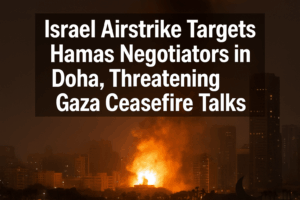
Israel struck Doha on September 9th—an attack that targeted Hamas political leaders during Gaza ceasefire negotiations and has pushed the Middle East into a new phase of instability. The incident killed at least six people, including a Qatari security officer and the son of a senior Hamas negotiator, and sent shockwaves through the already fragile Gaza peace process. The strike was remarkable not only for its timing, but for its location: an unprecedented Israeli operation on the sovereign soil of Qatar, a key player in Israel-Hamas mediation.
The immediate impact on the Gaza ceasefire talks has been devastating. Hamas quickly announced that its demands had not changed—insisting on a full ceasefire, Israeli withdrawal, humanitarian aid, and a prisoner-hostage exchange—while condemning Israel for sabotaging negotiations. Qatar, which has long played host to Hamas’ political bureau and served as a linchpin in past ceasefire talks, declared that the attack had “killed any hope” of a near-term agreement. The perception is now widespread that Israel is prioritizing military elimination of adversaries over a negotiated solution, a view reinforced by Prime Minister Benjamin Netanyahu’s repeated calls for the “total defeat” of Hamas. This narrative threatens to undermine confidence in ongoing Gaza peace initiatives.
For Qatar and the broader Gulf Cooperation Council (GCC), the strike represents not only a political affront but a strategic shock. Doha has convened emergency consultations, and GCC states from Saudi Arabia to the UAE have summoned Israeli envoys to protest the violation of sovereignty. An Arabic-Islamic leaders’ summit is scheduled for September 15 to discuss the situation created by the Israel strike. The summit will be attended by members of Arab League and Organization of Islamic Cooperation (OIC).
After decades of multibillion-dollar arms purchases and hosting of U.S. military bases, the GCC now confronts the reality that Washington either could not—or would not—prevent Israel from striking within their borders. The strike risks driving Gulf nations to reconsider their reliance on U.S. guarantees and to explore alternative security alignments. The Israeli strike has shaken Gulf confidence in the American security umbrella. Qatar’s Prime Minister Sheikh Mohammed bin Abdulrahman al-Thani also met with President Trump in New York on September 12 but the details of the meeting were not disclosed.
The Future of Hamas
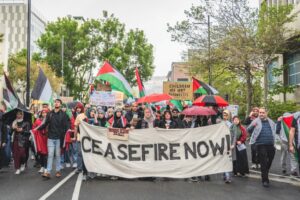 Whether Hamas keeps political and military control or is replaced in Gaza, and how any post-conflict governance would work, remains the key stumbling block. Israel has pressed for assurances related to demilitarization while Hamas rejects disarmament demands or removing its political authority without a full agreement.
For Hamas, its armed wing is more than just a military tool—it is central to its political identity. The group insists that its “weapon of resistance” is sacred and non-negotiable. In recent ceasefire discussions, Hamas has repeatedly declined to give up its military capabilities without a comprehensive deal that includes guarantees of Palestinian statehood, Israeli withdrawal, and full respect for humanitarian and governance rights. Any demilitarization demand, from this perspective, is seen as a demand for surrender.
On the Israeli side, demilitarization is non-negotiable. Israel views Hamas’s military and governing structure as the main obstacle to peace and security. Prime Minister Benjamin Netanyahu and other officials have made clear that any viable ceasefire or peace agreement must include: the destroying or dismantling of Hamas’s military infrastructure; the exclusion of Hamas from any future governance of Gaza; and the establishment of long-term oversight or guarantees that Gaza will not again become a base for armed attack.
For Israel, the demilitarization demand serves several purposes: a way to neutralize threats (rockets, tunnels, armed operations), to reassure its domestic political coalition especially hardline elements who see any compromise as weakness, and to prevent the recurrence of another large-scale conflict.
Third-party mediators, including Egypt, Qatar, and the United States, recognize that full instantaneous demilitarization is extremely unlikely. Hamas is deeply embedded in Gaza society, not only militarily but also through governance, social services, charities, religious institutions, and local legitimacy. Stripping it of arms without offering political, security, and governance compensations risks collapse of both trust and order.
The Israeli strike on Hamas negotiator’s in Doha can be seen as a tactics to pressure Qatar, and other Arab interlocutors, to support the demand for not only disarming Hamas-but to prevent any future role for the group in governance. Not doing so, now risks their own security.
Religious Dimension
By striking Hamas negotiators on Sunni Arab soil, Israel risks reframing its conflict as a broader war against Islam. For years, Israel’s regional clashes were directed largely against Shiite state actors such as Iran and groups affiliated with it. By striking Hamas leaders on Sunni Arab soil, Israel may have inadvertently broadened perceptions: that its war is not just against specific militant or extremist groups, but against Islam itself.
This is precisely the narrative that the U.S. sought to avoid during the War on Terror when American officials took pains to distinguish between global extremist movements like Al Qaeda and Daesh, and groups with localized political grievances like the Afghan Taliban. Ironically, the Taliban peace deal that the U.S. eventually negotiated was known as the Doha Accords, named for the very city that has now been bombed by Israel. The targeting of Hamas negotiators in Doha erodes the perception that there are safe spaces for diplomacy, and risks fueling extremist narratives.
Netanyahu’s own trajectory adds fuel to this interpretation. In recent weeks, he has doubled down on settlement expansion in East Jerusalem and the West Bank, bluntly declaring that “there will be no Palestinian state.” Reports suggest he has ordered preparations for a full military takeover of Gaza, with evacuation of civilian populations and consolidation of Israeli control.
At the same time, momentum is building at the United Nations for recognition of Palestinian statehood. The non-binding resolution sponsored by France and Saudi Arabia, named the ‘New York Declaration’, was presented on September 12. The resolution supporting the two-state solution was endorsed by 142 states with 12 nations abstaining. U.S. and Israel voted against the resolution. Netanyahu is expected to reject such recognition outright, portraying it as a reward for terrorism and a betrayal of Israeli security. Indeed, his government may respond by accelerating annexation policies to establish irreversible “facts on the ground.”
Implications for US
For the United States, the diplomatic fallout is complex. Qatar has been a vital partner in Hamas mediation and hostage negotiations and hosts the largest U.S. airbase in the Middle East. The GCC’s strategic importance to U.S. energy, counter-terrorism, and anti-Iran strategies makes the Israeli strike particularly sensitive.
Israel, meanwhile, remains Washington’s closest regional ally. The strike in Doha thus forces U.S. policymakers to confront the uncomfortable question: will American policy sacrifice credibility with Arab allies to defend Israel’s unilateral actions? The Trump administration’s own dismay was evident when President Trump declared himself “very unhappy” with the strike. The incident comes at a critical time for the Abraham Accords, the Trump initiative carried over from his first term, to normalize Israel’s relations with Arab states, potentially undermining Israel-Gulf diplomatic relations.
The implications for U.S. strategy are stark. Washington risks losing its credibility as a mediator, damaging its relations with the Gulf, and undermining its own long-term vision for Middle Eastern stability while benefiting China and Russia. More dangerously, it risks fueling the perception that Israel—and by extension its American backer—is engaged in a wider war against Islam. This perception could radicalize new generations across the Arab and Muslim world, erasing the careful distinctions that U.S. officials have drawn for decades between extremist groups and sovereign states.
The Israeli strike on Qatar is a wake-up call. It threatens not only the Gaza peace process, but the entire architecture of U.S. strategy in the Middle East. Unless Washington can re-balance its approach—standing firm on sovereignty, reviving diplomacy, and reaffirming its partnerships—it risks watching both the peace process and its regional influence collapse.
Related Articles:
Gaza Ceasefire Plan And US-Iran Tensions – April 26, 2025
Two-State Solution, Future Of Gaza, And Iran – February 25, 2025
Assad’s Demise And The Shifting Balance Of Power In Middle East – Dec 26, 2024
The Escalating Middle East Crisis And President Elect Trump – Dec 5, 2024
Iran’s Potential Retaliation For Haniyeh’s Killing And Wider Consequences – Aug 30, 2024
The Iran-Pakistan Gas Pipeline Project: Economic and Geopolitical Realities – Sep 27, 2024